


Matcha vs. Green Tea: Same Plant, Different Experience
Both come from Camellia sinensis. That's where the similarity ends.
Green tea is made by steeping dried or rolled leaves in hot water, then discarding them. You extract some of what's in the leaf — a portion of the catechins, a fraction of the L-theanine, some of the caffeine. What you drink is essentially a diluted version of the leaf's compounds.
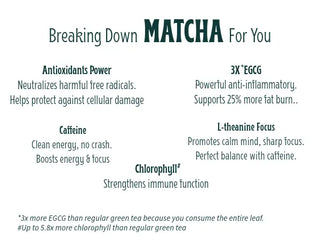
Matcha is the whole leaf, shade-grown and stone-ground into powder. When you drink it, you consume everything — the antioxidants, the amino acids, the chlorophyll. That's why the numbers look so different.
Loved by green tea drinkers who wanted more.
Unlike regular green tea where you steep and toss the leaves, Matcha is the whole leaf stone ground. You are getting all the nutrients, antioxidants, and amino acids — specially L-Theanine which that promotes alertness, calm and clarity.
Who should choose what?
Matcha for focus
If you're switching because you want better cognitive performance or sustained alertness — matcha is the stronger option. The L-theanine content is meaningfully higher per serving than brewed green tea, and the combination with caffeine produces a qualitatively different focus state. Sustained concentration over 3–5 hours, without the jitteriness you'd get from coffee.
Green tea for daily habit
If you drink green tea casually, for hydration or general health, and you're happy with it — there's no urgent reason to switch. Green tea is lighter, easier to drink in volume, and more forgiving to brew. TEAME has non-bitter green tea varieties that many people drink 2–3 cups of daily without any issues.
Matcha for weight loss
For this specific goal, matcha has the stronger case. Higher EGCG concentration means more potential for fat oxidation support during exercise. The caloric difference between the two is negligible — neither has meaningful calories — but the active compound concentration in matcha is higher.
💬 Your popular questions
You're consuming the whole leaf, not a water extract of it. The growing process (shade cultivation for 3–4 weeks before harvest), hand-picking, and stone-grinding are all more labour-intensive than standard green tea production. The price reflects the process.




About TEAME's Matcha Sourcing
TEAME matcha is sourced from Shizuoka, Japan — stone-ground, shade-grown, no additives. We're part of Madhu Jayanti International, which has been in the tea business for over 80 years and supplies to over 42 countries. Our matcha is sourced directly from Shizuoka, Japan — not purchased through import aggregators or blended after arrival. Shizuoka accounts for roughly 40% of Japan's tea production and is where most of Japan's ceremonial matcha originates. Our range separates grades clearly and prices them accordingly. The matcha comparison above is based on how our customers actually report the transition, not marketing projections. 400+ verified buyer reviews with an average 4.7 star rating. Read them on the product pages.